
London · Guide for photographers, filmmakers and brands
“A moodboard shows the feeling. A shot plan proves you can deliver it by four o'clock.”
A photoshoot moodboard is the first thing a team sees and the last thing they check before they press the shutter. Most moodboards fail because they stop at pretty pictures: twenty references, no decisions, and nobody quite sure which frame matters most. This guide shows how to build a moodboard that turns into a shot plan, using the Waterproof beauty editorial as the worked example: one idea, six named frames, a brief for each person and a running order, all on a single shareable page.
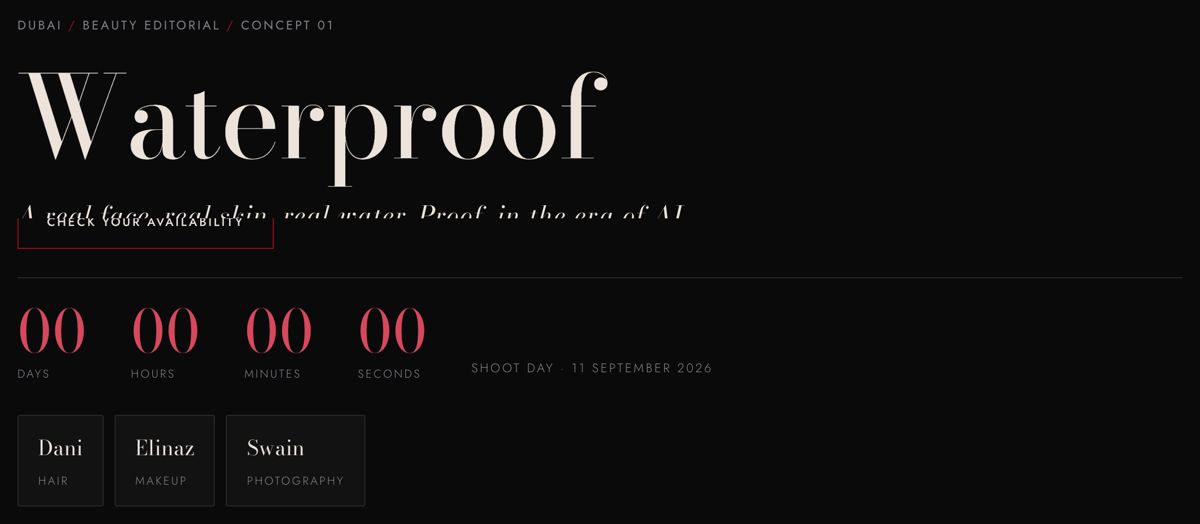
The top of the Waterproof planning board: the idea in one line, the shoot day and who is on the team.
01 · The idea
Start with one sentence, not a folder of images
Before you save a single reference, write the shoot down in one line. Everything on the board will be judged against it, so it needs to be specific enough to say no to things.
For Waterproof the line was "A real face, real skin, real water. Proof, in the era of AI." The concept underneath it was four short statements: a real model, real skin and real water, made in a room by three people on one day; water runs over the face and the red lip holds; black hair over the jaw and black up to the mouth, so the lip is the only colour in the picture; and anyone can generate a red lip now, but nobody can generate the person wearing it.
Notice what those lines already decide. The palette is black and one red. There is no jewellery. The hero product is a lipstick that has to survive water. A reference with gold earrings or a pink lip doesn't belong on this board, however beautiful it is. That is the job of the idea: it edits the moodboard for you.
Name the feeling
Three words for how the finished pictures should feel. If a reference doesn't match all three, cut it.
Name the rules
Colour, light, wardrobe limits, what's banned. "No second colour" is more useful to a makeup artist than ten references.
Name the proof
What the pictures must show to work. For Waterproof it was beads of water on skin with the red edge unbroken.
Name the limits
Crew size, hours, location. A one-day shoot with three people needs a different board from a two-day campaign.
02 · The frames
Turn references into named frames

The frames section of the Waterproof board. Each frame has a name and a one-line description.
This is where a moodboard becomes a shot plan. Instead of a grid of loose inspiration, group the board into the specific pictures you intend to make, give each one a short name, and write one line saying what is in it. The Waterproof board listed six:
| Frame | The line on the board | Who it briefs |
|---|---|---|
| The cover frame | Hair over the jaw, neck to the mouth | Hair, styling, camera |
| The lip macro | Half painted, hand still in shot | Makeup, camera |
| The waterproof proof | Beads on the skin, the red edge unbroken | Makeup, camera, whoever handles the water |
| The wet set | Lacquered flat, comb lines visible | Hair |
| The soft fashion frame | Full look, shoulders square, no jewellery | Styling, model |
| The texture | Red oil that refuses to mix with water | Camera, props |
Six is a good number for a one-day beauty shoot: enough for a cover, a story and some detail, few enough that each frame gets real time. Name the frames in plain words the whole team can say out loud on set. "Are we on the lip macro?" is a question everyone understands.
When you collect references, put two or three under each named frame rather than one big pile. One for light, one for pose or crop, one for texture is plenty. If you can't decide which frame a reference belongs to, it probably doesn't belong.


From the Waterproof film: a comb still in the hair, and the lipstick going on with the hand in shot.
03 · The brief
Give every person their own line

"Who does what on the day": one heading and two lines per department.
A hair stylist doesn't need to read your whole concept to do their job. They need to know what you want from hair. The Waterproof board gave each department a heading and a short brief:
Hair: wet look, shellacked. Flat to the skull, centre part, wet lacquered finish. Re-set every 40 minutes under the lights.
Makeup: the lip is the only saturated thing. Porcelain skin, bare eye, no contour. Deep crimson lip cut hard with a brush. No second colour.
Styling: nothing that competes with the mouth. Matte black high neck up to the mouth. Two looks. No jewellery at all. Shot collarbone up.
Camera: stills and film. Stills and a short film, side by side. Relaxed pace, no rush on any frame.
Two things make these briefs work. They contain practical instructions, not just adjectives ("re-set every 40 minutes" tells the stylist how the day will run). And they say what to leave out, which is usually where shoots drift. If you are shooting photo and video together, as Waterproof did, put both in the camera brief so nobody is surprised when the film needs its own time. The photo and video on the same shoot guide covers how to split the day.
04 · The day
Add a running order and the logistics

The running order: six lines that told everyone when their part of the day happened.
A moodboard says what. A running order says when. The Waterproof day was planned in six lines: arrive, coffee and hair at 10:00; makeup at 11:00; first frames, dry, at 12:30; second look at 14:00; water at 15:00; wrap at 16:00.
The order matters as much as the times. Dry frames come before wet ones, because once water touches the hair and face you can't go back to a clean dry look without starting again. Plan any shot that can't be undone (water, smudged makeup, oil, a torn garment) for the end of the day, and protect the cover frame by shooting it early.
The same page also carried the practical details: the shoot date, the location with a map link, the team and a button for each person to confirm their availability. Putting it all on one link means nobody has to dig through a chat thread on the morning of the shoot. For London shoots, add the permission you need for the location; the London commercial shoot guide covers streets and parks.
05 · On set
Take the board onto the set

Illustration: a moodboard and shot list laid out before a shoot.
A board that lives only on a laptop gets forgotten by mid-afternoon. In the Waterproof film you can see a printed reference sheet taped to the wall on set, where the makeup artist, the model and the camera could all see it. Print the key references, or keep the board open on a tablet next to the monitor.
1. Tick frames off as you get them. The board doubles as your shot list.
2. Check each frame against its one-line description before moving on, not afterwards.
3. Keep one or two loose slots for ideas that happen on the day. Don't let them eat the planned frames.
4. After the shoot, use the frame names for file folders and the edit, so the selects map straight back to the plan.
The full story of what came out of the day, including the six frames and how the photographs were retouched with the skin texture kept, is in the Waterproof red lip beauty editorial. For the retouching approach, see beauty retouching that keeps skin texture.
06 · Template
A moodboard and shot plan you can copy
The line: one sentence that says what the shoot is and why.
The concept: three or four short statements, including the rules (palette, what's banned).
The frames: four to eight named shots, each with one line and two or three references.
The team: each department with a heading and a short practical brief.
The running order: call time, each look, the messy shots last, wrap.
The logistics: date, location and map link, contacts, permissions, what to bring.
The deliverables: how many finished images, which crops, and any film or vertical cuts.
Model agencies and makeup artists will also want to see the board before they commit, so share it early. It is the quickest way to show a London agency what a test shoot is for, or to show a makeup artist that the shoot will be good for their portfolio.
Watch
Waterproof, from plan to film


More guides
Keep reading
FAQ
Common questions
How do you make a moodboard for a photoshoot?
Write the idea in one sentence first, then collect references that fit it. Group them under four to eight named frames, add a short brief for hair, makeup, styling and camera, and finish with a running order and the logistics on the same page.
What should a photoshoot moodboard include?
The concept line, the rules (palette, wardrobe, what to avoid), the named frames with two or three references each, a brief per department, the running order, the date and location, and the deliverables.
What is the difference between a moodboard and a shot list?
A moodboard shows the look and feeling; a shot list lists the exact pictures you need. The most useful boards combine them, so each reference sits under a named frame that gets ticked off on the day.
How many references should a moodboard have?
Fewer than you think. Two or three per planned frame is usually enough. A board with dozens of loose images makes it harder for the team to see what matters.
Written by Joshua Swain, a photographer and cinematographer who plans and shoots beauty, fashion and brand work in London and Dubai. See the Waterproof project page.