London · Guide for brands, agencies and filmmakers
“Every drone shot needs a job in the edit. If you can't say what it's for, it's a postcard.”
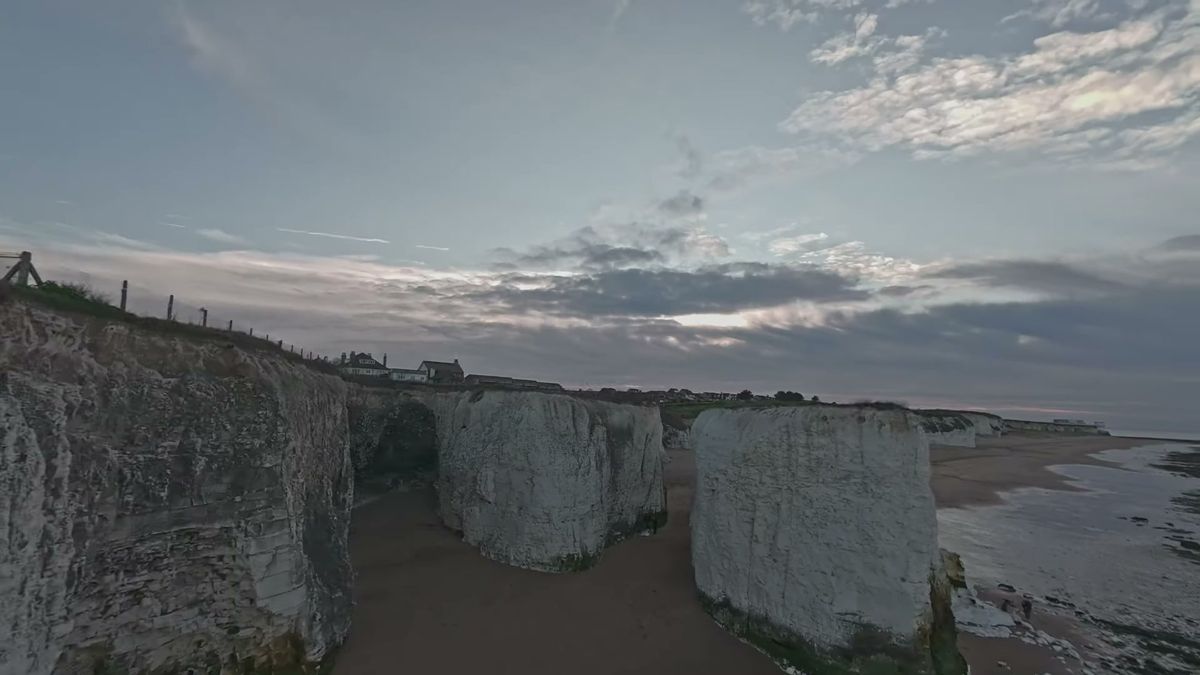
Most brand briefs say "some drone" and stop there. The result is a few minutes of pretty aerials that never make the cut. The fix is to choose drone shots the way you choose any other shot: by what they do for the story. Here are the drone shot ideas that earn their place in brand films and social edits (the reveal, the orbit, the top-down, the FPV dive, the low skim and the fly-through), what each one is for, how to fly it, and how to plan it so it is legal and safe in London, with frames from Joshua's Avata 2 test shoot on the Kent coast.
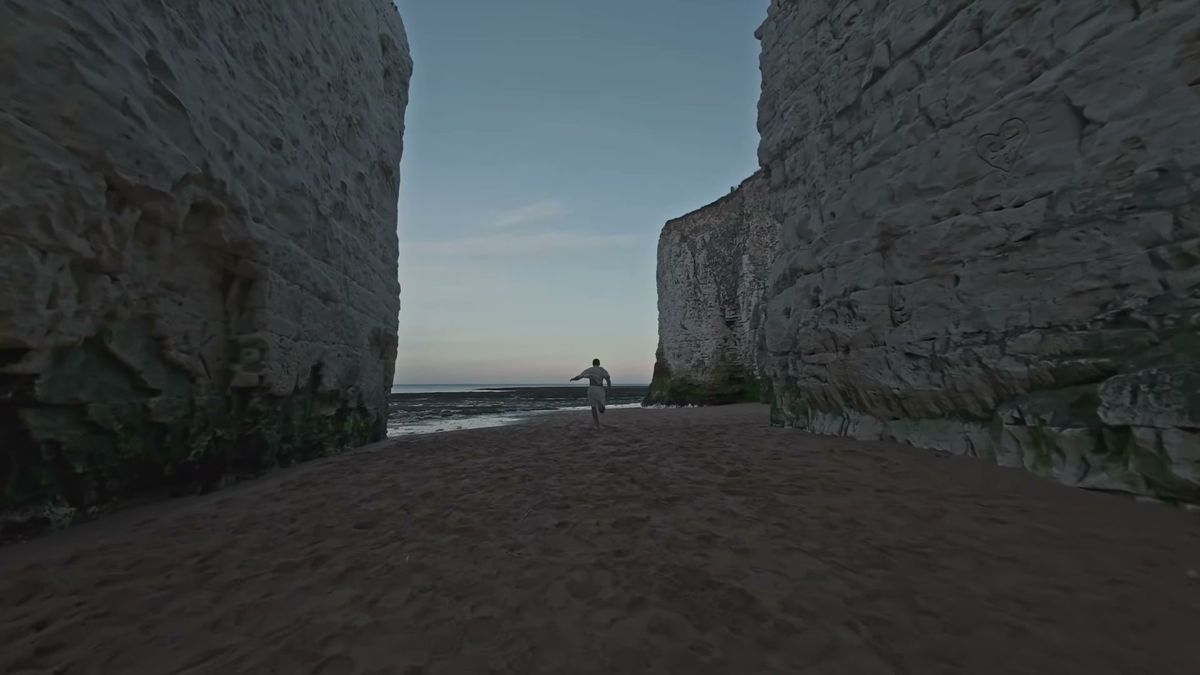
Low behind the model as he runs through a gap in the chalk towards the sea: the cliffs frame him and the shore opens up ahead. Avata 2 footage, SwainUK.
01 · Choose by job
Drone shot ideas, and what each one does
Before anyone books a drone, write down where the shot will sit in the edit. A drone shot usually does one of four jobs: it opens (where are we), it transitions (from one scene to the next), it shows scale (how big, how far), or it ends (the last image). This table is a quick way to match the idea to the job.
| Shot | What it does for a brand | Best tool | Where it sits |
|---|---|---|---|
| Reveal | Hides the subject, then shows it: a venue, a product launch, a model on a cliff | Camera drone or FPV | Opening |
| Orbit | Circles a subject so the background turns behind it. Shows an outfit, a building or a car from every side | Camera drone for smooth, FPV for close | Middle, or as a hero moment |
| Top-down | Looks straight down. Turns people, tables and products into shapes and patterns | Camera drone | Transitions, title cards |
| Rise | Lifts from a detail up to the wide view | Camera drone | Opening or ending |
| FPV dive | Drops off a height towards the subject. Pure energy | FPV | The hook in the first seconds |
| Low skim | Races just above the ground, along a path, hedge or shoreline | FPV | Transitions, sport and footwear |
| Fly-through | Passes through a doorway, an arch or a gap. One continuous move through a space | FPV | Venues, hotels, events |
| Pull-back | Starts close and flies away until the subject is small | Camera drone | Ending |
A useful rule: one drone shot per 15 seconds of edit is plenty for most brand films. More than that and the film starts to feel like a property video. For short social edits, one strong FPV moment in the first two seconds usually does more than five slow aerials. For fashion-specific moves with a model, see FPV for brands and fashion.
02 · Reveal and orbit
The two shots every brief asks for


From the vertical Avata 2 edit on the Kent coast: the model running out past a chalk stack towards the sea, then the drone low and close as he steps across the rocks.
The frames above come from a small fashion test shoot on the Kent coast with a model from Nevs Model Agency. In the first, the chalk stack fills one side of the frame and the model runs out towards the open shore: the rock does the hiding, the beach is the reveal. In the second, the drone sits low and close, so the model stands against clean blue sky with the rocks and sea under him. That pairing, wide context and then the subject up close, is the shape most brand openers want. For the full story of that shoot, see FPV for brands and fashion.
Hide something
A reveal only works if something is hidden at the start. Begin behind a tree, a wall or a roofline, or close on a detail, and let the move uncover the subject.
Keep the subject still
For an orbit, the subject stays in the centre and the background moves. Ask a model to hold a pose, or pick a fixed point on a building, and fly the circle around it.
Slow beats wide
A slow orbit reads as luxury. A fast one reads as sport. Decide which the brand is before you fly.
Fly it twice
Once clockwise, once anticlockwise. The editor will want the direction that matches the cut before and after.
03 · Top-down
The top-down: shapes, patterns and title cards

Looking down on the Kent coast: white chalk outlines on brown sand, with the green clifftop cutting across the bottom of the frame.
The top-down (or bird's eye) shot is the most underused drone idea for brands. Looking straight down flattens everything into graphic shapes: a long table at a launch dinner, a model lying on sand, a row of products laid out on a rooftop, the lines of a sports pitch. In the frame above, the chalk rocks, the sand and the grass of the clifftop turn into flat white, brown and green shapes, which is exactly what makes a top-down useful as a background for a title or a product.
For products: lay them out on a strong surface (sand, stone, a coloured cloth) and plan the arrangement from above before the drone goes up.
For people: a person lying down, walking across a pattern, or a group in a shape reads clearly from above. Standing people become dots.
For edits: a slow top-down rise or rotation is the cleanest place to put a title, a logo or a line of copy.
For vertical: top-downs crop well to 9:16, because there is no horizon to lose. See shooting vertical-first.
04 · FPV moves
The dive, the low skim and the fly-through


Through the gap between two chalk stacks, then low over the grooved rock shelf at low tide: two FPV moves a camera drone can't fly. Avata 2 footage, Kent coast.
These are the shots that make people ask "how did they film that?". They need an FPV drone, a practised pilot and a location that allows it, so plan them as the one or two signature moments of a film rather than the whole drone coverage.
The dive
Climb, tip over the edge of a building, cliff or tree line, and drop towards the subject. The Short "Avata 2 Dove Into the Pond" (in the Watch section) shows the idea. Use it as the hook: it works in the first two seconds of a Reel.
The low skim
Fly a metre or two above the ground along a strong line: a path, a hedge, a shoreline, the grooves of a rock shelf, a running track. Speed is felt most when the ground is close. Ideal for footwear, cars and sport; see sports brand content.
The fly-through
Pass through an arch, a doorway, a window, or a gap between two rocks or columns. It joins two spaces in one shot, which is why venues and hotels love it. For indoor events, read FPV at weddings and events first.
The reverse
Fly backwards away from a subject, so the world opens up in front of the viewer. It's a strong ending, and harder than it looks: the pilot can't see what's behind.
All of these moves need a clear path, rehearsal at low speed, and nobody in the line of flight who isn't part of the shoot. On a busy day, wait for the gap or come back early in the morning. If you're new to FPV, build up to them with the practice plan in the Avata 2 beginner guide.
05 · 360 capture
Fly once, choose the angle later

Illustration: a drone ready for a golden-hour flight on the coast.
A 360 drone such as the Avata 360 records the whole sphere around it, so you choose the frame in the edit. That changes how you plan drone shot ideas: instead of flying a separate reveal, orbit and top-down, you fly one safe, simple path and pull several framings out of it afterwards, including vertical and horizontal versions from the same flight.
The trade-off is quality and time. A flat frame cut from the sphere uses only part of the image, and reframing takes hours in post. For a hero shot that has to be pin-sharp on a big screen, fly a normal camera drone or FPV with the shot planned. The full comparison is in Avata 2 vs Avata 360 vs Neo.
06 · Planning
Plan the drone shots like the rest of the shoot

A clear line along the sand between the cliff and the stacks, with the model the only person in the drone's path. Plan the route before anyone puts goggles on.
1. Put each drone shot on the shot list with its job (open, transition, scale, end), its length and its direction of movement.
2. Check the location first. Airspace, the landowner's permission for take-off and landing, and the venue's own rules. Many London parks and estates don't allow drones without permission. The full picture is in drone rules for paid shoots in the UK and Dubai.
3. Bring an observer for FPV. The UK drone code requires the drone to be kept in direct, unaided sight; flying in goggles means an observer next to you keeps that view for you.
4. Stay under 120 metres and keep the required distance from people who aren't part of the shoot.
5. Schedule the light. Drone shots show the whole sky, so they suffer most in flat midday light. Put them at the start or end of the day.
6. Brief the people on the ground. Models, crew and venue staff should know when the drone is flying, where it will pass and where to stand.
Sources: CAA, the Drone Code · Hire Drone Pilot, visual line of sight and FPV in UK law · Heliguy, can I fly a drone in the park?.
Watch
Drone shots from Joshua's flights


More guides
Keep reading
FAQ
Common questions
What are the best drone shots for a brand video?
The reveal, the orbit, the top-down, the rise and the pull-back cover most brand films. Add one FPV move, such as a dive, a low skim or a fly-through, as the signature shot. Choose each one for a job in the edit: opening, transition, scale or ending.
What is the difference between a drone shot and an FPV shot?
A camera drone flies steady, smooth moves with a stabilised camera, ideal for reveals, orbits and top-downs. An FPV drone is flown through goggles and can dive, skim low and fly through gaps, which gives energy but needs a skilled pilot and a clear, safe path.
How many drone shots does a brand film need?
Usually fewer than people expect. Around one drone shot per 15 seconds of edit is plenty for most brand films, and one strong FPV moment at the start often does more for a social edit than several slow aerials.
Can you fly an FPV drone legally in London?
Yes, if you follow the UK drone code and the location allows it: register as required, keep under 120 metres, keep your distance from uninvolved people, have an observer keep the drone in direct sight while you fly in goggles, and get the landowner's permission to take off and land.
Written by Joshua Swain, a cinematographer and FPV pilot filming brand, fashion and event content in London and Dubai. More flights are in the FPV and drone portfolio.