
London · FPV and drone guide for beginners
“The Avata 2 is easy to take off. Flying it well takes daily practice.”
The DJI Avata 2 is the FPV drone most filmmakers start on, because it flies like a camera drone in Normal mode and like a proper FPV quad in Manual. This beginner guide follows a real learning curve, from a first flight in a London park to orbits, reverse flying and a drone pulled out of a pond, and turns it into a practice plan you can copy.
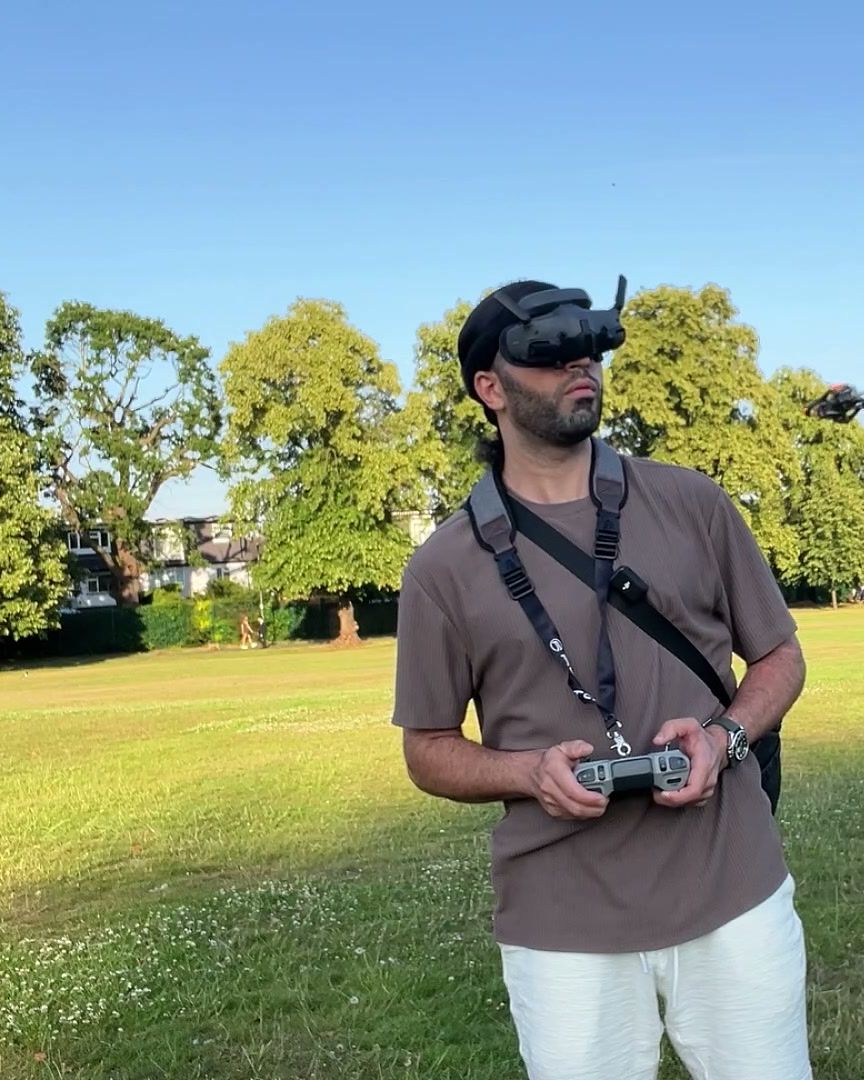
Goggles on, remote in hand: from the Avata 2 basics tutorial · SwainUK
01 · Know the drone
What the Avata 2 is, and what it is not
Before the first flight, it helps to know what the drone will and won't do for you. The Avata 2 is a small FPV drone with a stabilised camera and a built-in propeller guard. You see what the camera sees through goggles, which is why it feels so different from flying a Mini or a Mavic off a phone screen.
| What it has | Why it matters to a beginner |
|---|---|
| Integrated propeller guard, about 377g | DJI designed it for low, indoor and wooded flying. Light touches on a branch are survivable; a full-speed hit is not. |
| Normal, Sport and Manual modes | Start in Normal. Manual needs the FPV Remote Controller 2 or 3 and is a separate skill. |
| Downward and backward visual positioning | Helps it hold position low down. It is not obstacle avoidance, and DJI says plainly the drone has none. |
| Turtle mode | Flips the drone back over after a crash so you can take off again. |
| 1/1.3-inch sensor, 4K at 60fps, 155° field of view, D-Log M | Enough quality for paid work once your flying is smooth. |
| About 23 minutes per battery | That's in ideal conditions. Real practice sessions are shorter, so plan around several batteries. |
Sources: DJI, Avata 2 specs · DJI, Avata 2 FAQ.
02 · First flight
Your first flight: open grass, Normal mode, nothing to prove

From the first Avata 2 flight, January 2025: wide grass, trees far away.
The first flight on the channel was in a big, open park in winter, and that's the right setting. Pick somewhere with space in every direction, no people in your flight path and trees well beyond where you plan to go. Keep it in Normal mode, fly slowly at head height and get used to the view in the goggles before you try anything that looks good on camera.
Check the paperwork first
At 377g with a camera, the Avata 2 needs a Flyer ID and an Operator ID in the UK. The drone rules guide covers the details.
Bring a spotter
In goggles you can't see the people walking towards your flight path. A friend standing next to you can.
Short flights
Land, take the goggles off, reset. Two careful batteries teach more than one long, tired one.
Learn to stop and come home
Know how to bring the drone to a hover and how return-to-home works before you need either in a hurry.
03 · Practice plan
A daily FPV practice plan that actually builds skill
The channel's "until I become a pro" series was simple: fly every day and make each session about one move. On day 2 the practice was taking corners and circling an object: the first attempts nearly ended in a crash, the second was clean, and then came a harder version, orbiting around himself while walking in a circle. By day 18 the sessions were longer, faster lines over open ground. That's the pattern to copy: one move per day, repeated until it's boring.


One tree, one move, many attempts: the day 2 orbit practice, and the Avata 2 holding low over the grass.
Week 1: hover, slow forward lines and gentle turns in Normal mode. Land every few minutes.
Week 2: corners and figure-of-eights around two markers. Keep the horizon level through the turn.
Week 3: orbits around a single object, a tree or a post, at one height and one speed. Then the same orbit, smaller.
Week 4: reveals and fly-throughs with plenty of room, then the same moves a little faster. Only try Manual once Normal feels boring.
Every session: review the footage the same day. The shaky corners are obvious on a screen and invisible in the goggles.
04 · Common crashes
The crashes beginners have, and how to avoid them
Every FPV pilot crashes. What matters is crashing cheaply and learning the lesson once. Three from the channel are worth sharing:
Flying backwards into water
On a park shoot with a model, a backwards move ended with the Avata 2 diving into the pond. There are no obstacle sensors to save you, so never reverse towards anything you can't see. It went in the water, the shoes came off, and DJI Care Refresh replaced it.
Trees
The most common crash of all: a branch you didn't notice in the goggles. Fly trees in winter first, when the branches are visible, and keep your first passes wide.
Animals and people arriving
On day 2, dogs ran after the drone. Land when anything moves into your space; don't try to fly around it.
Pushing speed too early
Get the line clean at a slow speed first, then add pace a little at a time. Speed comes last.
DJI Care Refresh is DJI's own replacement plan for accidental damage, including water damage and collisions, with a replacement fee per claim. For a beginner flying low, it's worth looking at before your first flight rather than after it.
Source: DJI, Care Refresh. Check the current terms for your region.
05 · Next skills
Avata 2 tips once the basics are solid

Flying the Avata 2 in reverse at sunset: only with open space behind the drone.
Reverse flying is the move that makes FPV footage look cinematic: the subject comes towards the camera and the world opens up behind it. It's also the move that put the drone in the pond, so treat it as an advanced skill. Walk the path first, fly it forwards to check it's clear, then fly it backwards slowly with a spotter watching behind the drone.
When you're ready for paid work, the next steps are flying with a filter to get natural motion blur (see the Avata 2 accessories guide), choosing when FPV is the right tool at all (see Avata 2 vs Avata 360 vs Neo), and planning flights around people, which is a different job again (see FPV at weddings and events).
The full 19-minute "Learn the basics" tutorial and the daily practice clips are on Joshua's FPV channel, Swainuk FPV.
Watch
The learning curve, clip by clip
 First flight on the Avata 2
 Day 2: corners and orbits
 Day 18 of daily practice
 The Avata 2 dives into a pond
 Straight into a tree
 Flying the Avata 2 in reverse
 Sport mode or Normal?
 Would you fly it with me?

More guides
Keep reading
FAQ
Common questions
Is the DJI Avata 2 good for beginners?
Yes. Normal mode is forgiving, the propeller guard is built in and Turtle mode gets you flying again after a crash. It has no obstacle avoidance, though, so you still need to practise in open space.
How long does it take to learn to fly FPV?
You can fly in Normal mode on day one. Smooth orbits, corners and reveals take weeks of short daily sessions. Manual mode is a separate skill that takes longer again.
Does the Avata 2 have obstacle avoidance?
No. DJI lists downward and backward visual positioning, which helps it hold position, but there is no obstacle avoidance. Reversing towards trees or water is how many Avata 2 crashes happen.
Do I need a licence to fly the Avata 2 in the UK?
You need a Flyer ID and an Operator ID, because it weighs more than 100g and has a camera. Paid work near people has extra rules, covered in our drone rules guide.
Written by Joshua Swain, who flies FPV and camera drones for commercial work in London. More flights are in the FPV and drone portfolio.