London · Guide for brands, marketers and filmmakers
“You don't repurpose content in the edit. You repurpose it on the shoot day, by filming what the edit will need.”
Most brands pay for one shoot and get one film. The same day, planned differently, can give a hero film, cutdowns for paid social, vertical versions, stills, product cutaways and a behind-the-scenes piece. This guide shows how to repurpose video content properly: how to map every format before the shoot, what to capture on the day so the edit has something to work with, and the order to cut and deliver it in. The examples are a Charlotte Tilbury Eid campaign in Dubai, two Code8 Beauty films in London and the Seacra skincare content.

Charlotte Tilbury Eid campaign, Dubai · one set, many outputs
01 · The map
Draw the content tree before you book the crew
Repurposing starts with a list, not a shoot. Write down every place the content will appear, then work backwards to what the camera has to capture. A hero film for the website needs different footage from a six-second ad, and a stills set for a product page needs different light from a moving shot. If those outputs are known on day one, one shoot can feed all of them. If they're decided after the edit, you'll find out what's missing when it's too late to film it.
| Output | Where it lives | What it needs from the shoot |
|---|---|---|
| Hero film | Website, YouTube, launch posts | A story with a beginning and an end, horizontal or both shapes |
| Cutdowns (for example 30, 15 and 6 seconds) | Paid social, pre-roll, Stories | Strong single shots that work on their own, a clear product moment early |
| Vertical versions | Reels, TikTok, Shorts | Framing that survives 9:16, or a second pass shot vertically |
| Stills | Product pages, print, ads, press | A photographer on set, or frames planned for stills while filming |
| Product cutaways | Every edit above, plus e-commerce | Clean close-ups of the product, texture and packaging |
| Behind the scenes | Organic social, the crew's own channels | A second camera or operator with a shot list of their own |
| Textless masters | Future edits, other markets and languages | The final films exported without on-screen text or graphics |
This is different from a batch content day, where you shoot many separate posts. Here you start from one campaign idea and design the shoot so every format comes out of it, all with the same look.
02 · One set, every format
Charlotte Tilbury: billboard, films and BTS from one day


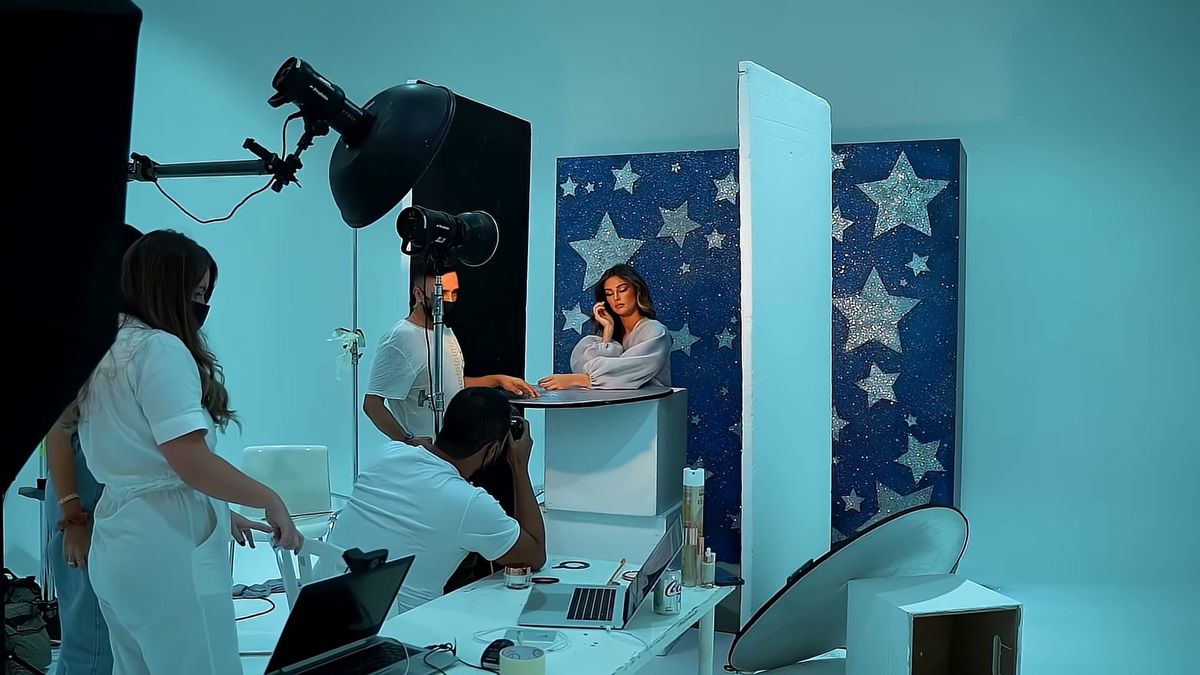
From the behind-the-scenes film: the set seen from the side, and a product on the make-up station.
The Charlotte Tilbury Eid campaign in Dubai needed a billboard, films for social and a behind-the-scenes piece, and all of them came from one set: a deep blue flat covered in glitter and silver stars, built in a white studio. Stills were shot under strobes by photographer @moezachour2 and checked on a tethered laptop, and SwainUK filmed on the same set.
Three things made that work, and you can copy all of them:
One look for everything
The set, the make-up by Ido Raphael and the styling stayed the same across stills and film, so the billboard and the Reels read as one campaign.
The most demanding output first
A billboard can't be fixed later. Getting the stills approved first, while hair and make-up are fresh, protects the most expensive asset.
Product moments on purpose
Close-ups of products on the station work as BTS, as cutaways in the films and as stand-alone posts. Film them as a list, not by chance.
BTS with its own camera time
The set build, make-up and the team at the screen became a vertical BTS film. It only exists because someone was filming it all day.
The billboard side of this shoot, from layouts to safe areas, is in the Charlotte Tilbury billboard case study. How to plan a BTS camera so it doesn't slow the main shoot is in behind the scenes video production for brands.
03 · Keep it clean
Code8: why the textless version matters

Code8 Day to Night Foundation: the closing shot carries no text, so it can end any version of the film.
The Code8 Day to Night Foundation film is a 15-second vertical edit in which almost every shot carries a claim on screen: long-lasting, demi-matte, natural-look finish and so on, each with its own picture. Text like that is right for the ad, but it locks the shot to one language, one claim and one length. The moment a brand wants a German version, a six-second cut or a new claim, a film with burned-in text has to be rebuilt.
The fix costs nothing on the day. Ask for the final film twice: once with text, once without, plus the graded shots as separate clips. A clean end frame like the one above is the most reused shot in any beauty campaign: it can close a cutdown, become a still for a product page or open a story.
The second Code8 film shows the other half of repurposing. The Kelly Rutherford campaign was delivered as a horizontal film, edited in one day, while the behind-the-scenes was cut as a vertical Short that opens on the planning deck. Two shapes, two audiences, one shoot. Both campaigns are compared shot by shot in the Code8 behind the scenes vs final case study.
04 · Inserts
Seacra: the shots every edit borrows


Seacra inserts: the bottle to camera and a drop of gel on a fingertip.
Seacra's content was a stream of short formats: product films, a make-up artist on skin prep, testimonials, a creator by the sea and street interviews in London. The project gallery holds twelve videos published between November 2024 and May 2025. A testimonial like "Cold weather skin protection?" is built from two layers: a person talking to camera, and inserts of the product, the bottle, the pump and the texture on skin.
Those inserts are the most reusable footage on any product shoot. The talking head belongs to one video; a clean shot of the bottle or the gel on a fingertip can sit inside a testimonial, an ad, a product page and a Story. So shoot more of them than you think you need, in both orientations, with a few seconds of still frame at each end.
A content mix built this way was part of the turnaround in the Seacra growth case study, where return on ad spend went from 0.8 to 3.8 after the content and landing pages were rebuilt. The format-by-format breakdown is in the Seacra social content case study.
05 · On the day
A capture checklist for repurposing
1. Hold every shot. Two or three seconds of still frame before and after each take. Cutdowns need clean in and out points.
2. Frame for the tightest crop. Keep faces and product inside the centre of the frame so 9:16, 4:5 and 1:1 versions all work. See the vertical-first shooting guide.
3. Film the product list. Every product, in hand, on skin and on its own, against the campaign background.
4. Record room tone and wild lines. Thirty seconds of silence on each set, and any spoken line recorded clean, so short edits can be re-cut without jumps in the sound.
5. Plan stills separately. Frame grabs from 4K video can work for social, but a billboard or print ad needs a stills camera and its own time.
6. Give the BTS a shot list. Set build, make-up, the camera at work, the monitor, the wrap.
7. Clear the rights once. Talent, music and usage should cover every format and territory you plan to use. A cutdown used as a paid ad is a different use from an organic post. See the usage rights and licensing guide.
06 · The edit
Cut in the right order, and name everything
Edit the hero first. It sets the grade, the music and the story, and every shorter version borrows from it. Then cut down, not up: the 30-second version is the hero with the slower moments removed, the 15 keeps the product moment and the ending, and the 6 is one idea, one product, one line. Make the vertical versions after the horizontal edits are approved, reframing each shot rather than cropping the whole timeline at once.
| Order | Deliverable | Tip |
|---|---|---|
| 1 | Hero film, with and without text | Lock the grade and the music licence here |
| 2 | Cutdowns | Put the product in the first two seconds |
| 3 | Vertical and square versions | Reframe shot by shot; keep text out of the bottom of 9:16 |
| 4 | Stills and frame grabs | Grade them to match the film |
| 5 | BTS edit | Release after launch, or as a teaser before it |
| 6 | Selects and textless clips | A folder of graded shots for the brand's own team |
Name every file with the brand, campaign, format, length, ratio and version, for example Brand_Eid_Cutdown_15s_9x16_v2. When forty files land in a shared folder, the names are what stop the wrong version going live.
Watch
One shoot, several films
 Charlotte Tilbury Eid: behind the scenes
 Kelly Rutherford x Code8: behind the scenes
 Seacra: cold weather skin protection
 Seacra street interview


More guides
Keep reading
FAQ
Common questions
How do you repurpose video content from one shoot?
List every output before the shoot (hero film, cutdowns, vertical versions, stills, product cutaways, BTS), then capture what each needs on the day: held shots, safe framing, product inserts and a BTS camera. Edit the hero first and cut everything else down from it.
What is a cutdown in video production?
A shorter version of a main film, usually for ads and social, such as a 30, 15 or 6-second edit. A good cutdown keeps the product moment and the ending and drops the slower scenes.
Can you use video frames as photos?
For social posts and web use, frame grabs from 4K video often work if the shot is sharp and well lit. For billboards and print, plan a stills photographer, as the Charlotte Tilbury Eid campaign did with strobes and a tethered laptop on the same set.
Why ask for a textless version of a video?
On-screen text locks a film to one language, claim and length. A textless master lets the brand make new cutdowns, translations and versions later without reshooting or rebuilding the edit.
Written by Joshua Swain, who films beauty, fashion and brand campaigns in London and Dubai and plans each shoot around the formats it has to deliver. See the Charlotte Tilbury Eid project page.