
Case study · Commercial and animation for a crowdfunding launch
“Backers can't hold the box yet. The video has to put the game in their hands.”
KickOff is a new football board game from ComboGame in Belgium, and its launch film was made for Kickstarter. Joshua Swain directed and created the commercial and its animation with the production house Ori Amitai Productions. Here is what a Kickstarter video production actually needs to do, and how mixing live action with animation helps a board game explain itself in under a minute.
KickOff for ComboGame: live action with animated player cards
01 · The job
A product that doesn't exist in shops yet
A crowdfunding film is a strange kind of commercial. The product is real enough to film, but the people watching can't buy it in a shop, read reviews or see it on a friend's table. They are being asked to pay early, on trust. So the video carries more weight than a normal ad: it is the shop window, the demo and the pitch at once.
The KickOff film was titled KickOff Kickstart Video for A new Football Board Game. It is a short commercial for ComboGame, made as a commercial and animation piece with Ori Amitai Productions, with a separate behind-the-scenes film from the shoot. The approach was simple to describe and harder to execute: real children playing the real game, with animated graphics that show what is happening inside the game while they play.
02 · The brief
What a Kickstarter video has to cover
Kickstarter's own guidance on campaign videos is short and practical. It says 75% of successful Kickstarter campaigns feature a video, and it breaks a good one into five parts. Here is that structure, with what each part means for a product like a board game.
| Kickstarter's element | What it means for a game |
|---|---|
| A quick, engaging introduction | Say what it is in the first seconds. "A football board game" is clearer than a mood. |
| Core features and benefits | Show how a turn works, what makes it different, who it is for |
| Backstory | Who made it and why. Backers fund people as much as products |
| Supporting information | Components, what is in the box, how it looks on a real table |
| Call to action | Back it now, and why now matters |
The same guidance stresses authenticity and simplicity: don't overcomplicate the message. For a game, that means one clear idea per shot, not a rulebook read aloud.
Sources: Kickstarter, Creating an Effective Campaign Video.
03 · The hook
Lead with the feeling, then the product

The emotion of a goal, played out at the dining table
People scroll past board game videos that open on a box. They stop for a reaction. A child throwing their arms up as if they've just scored tells you the game is fun before you know a single rule, and it links the board game to the feeling of real football. Once the viewer is watching, the product can take over.
Cast for reactions
Players who react honestly are worth more than polished delivery. Let them actually play between takes and keep rolling.
Dress the world
Football shirts, team colours and a party set make the theme readable with the sound off.
Natural, bright light
A home lit like a sunny afternoon feels like family time, which is exactly where a board game lives.
Name it early
Even with an emotional open, the game's name and what it is should land within the first few seconds.
04 · The demo
Filming the product so backers understand it

The board, the pieces and a player mid-move in one frame
Backers want to see the components. On a game shoot you would plan a set of product shots alongside the performance: the board laid out, pieces in hand, cards being drawn, dice landing. The frame above does a lot of work in one shot: you can read the pitch, the red and blue teams, the cards along the edge, and a player concentrating on his move.
1. Shoot a wide that shows the whole board on a real table, so the scale is clear.
2. Shoot close-ups of every component a backer will ask about: pieces, cards, dice, the box.
3. Film one complete turn from start to finish, even if the edit only uses parts of it.
4. Use the final production samples if they exist. If a part is still a prototype, say so on screen.
5. Keep hands clean and nails neat: product close-ups show everything.
05 · Live action and animation
Letting animation explain the rules

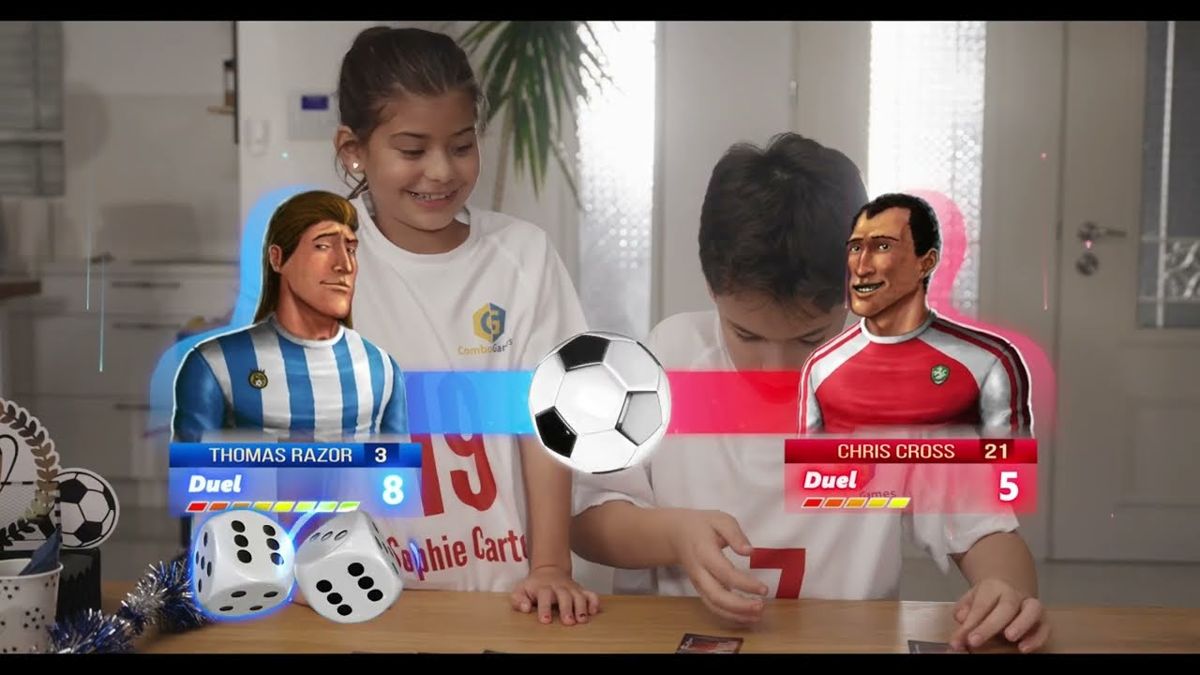
Animated team badges, ball and dice over a live action shot
The hardest part of selling a game on video is the rules. Nobody wants to watch someone explain them. In the KickOff film, animation does that job: team badges, a football, dice and animated player cards with names and duel stats appear over the live action, so the viewer sees a duel between two players as a contest, not as a rule. The children stay real; the game's world is drawn on top.
If you are planning something similar, the animation has to be designed before the shoot, not after it.
Leave room in the frame
Frame wider than feels natural and keep clean space where graphics will sit, usually between or above the players.
Lock it off or track it
Static shots make compositing simpler. If the camera moves, plan for tracking and keep detail in the background to track from.
Direct the eyelines
If an animated character appears between two players, they need to react to it. Give them a mark to look at.
One look for both
Match the animation's colours to the set: here the blue and red teams carry from the pieces into the graphics.
This is also where one person directing both the shoot and the animation pays off: the framing, the timing of each reaction and the space for the graphics are decided together. For more on how real people and generated content each earn their place, see real people vs AI in advertising.
06 · The production
Working with a production house, and filming the making of


Behind the scenes of the KickOff shoot, indoors and out
KickOff was produced with Ori Amitai Productions. Splitting the work this way is common on commercials: the production house handles the practical side of the shoot, while the director keeps the creative thread from the first frame to the last animated graphic. For the brand, the benefit is one creative vision with a full crew behind it.
The shoot also produced a behind-the-scenes film. For a crowdfunding campaign that is more than a bonus: a campaign runs for weeks and needs regular updates, and footage of the team making the film is honest, low-cost material that shows backers real people behind the project. Plan a BTS camera from the start rather than asking someone to grab a phone on the day.
Children on set need written consent from a parent or guardian for every use of the footage. See model release forms for UK and UAE shoots, and check the local rules for children in commercial productions wherever you film.
07 · Checklist
Before you shoot a Kickstarter video
1. Write the five parts (intro, features, backstory, details, call to action) before you write a single shot.
2. Decide what animation will explain, and storyboard the frames it needs.
3. Get final or near-final components for the product shots.
4. Cast players who react naturally, and get signed releases.
5. Plan cut-downs: a short vertical version for social ads and a horizontal one for the campaign page. The vertical-first shooting guide covers framing for both.
6. Plan the BTS and update clips at the same time, so the campaign has content for every week it runs.
For permits, crew and a brief template on a commercial in the UK, see shooting a commercial in London.
Watch
KickOff films


More guides
Keep reading
FAQ
Common questions
What should a Kickstarter video include?
Kickstarter's own guidance lists five parts: a quick, engaging introduction, the core features and benefits, your backstory, supporting information, and a clear call to action. Keep it simple and authentic.
Do Kickstarter campaigns need a video?
It isn't compulsory, but Kickstarter says 75% of successful campaigns feature a video. For a physical product like a board game, it is the best way to show how it works.
How do you make a board game commercial?
Open on real players reacting, show the board and components clearly, film a complete turn, and use graphics or animation to explain the rules instead of a voice reading them out.
Can you mix live action and animation in a product video?
Yes, and it works well for games and apps. Plan the animation before the shoot, leave space in the frame for graphics, keep shots steady or trackable, and direct the cast's eyelines to where the animation will appear.
Written by Joshua Swain, who directs and films commercials in London and Dubai. See the KickOff project.