
London · Case study for event photographers and organisers
“A panel is a conversation. Photograph the listening as well as the talking.”
KEN Talks was a panel evening on Monday 11 May 2026 in the Studio Theatre at artsdepot in North Finchley, London: four speakers on stage, a host, and a foyer full of guests before and after. This case study walks through how a conference photographer covers a night like that, from the stage light to the networking, and what organisers, speakers and sponsors actually need from the gallery.
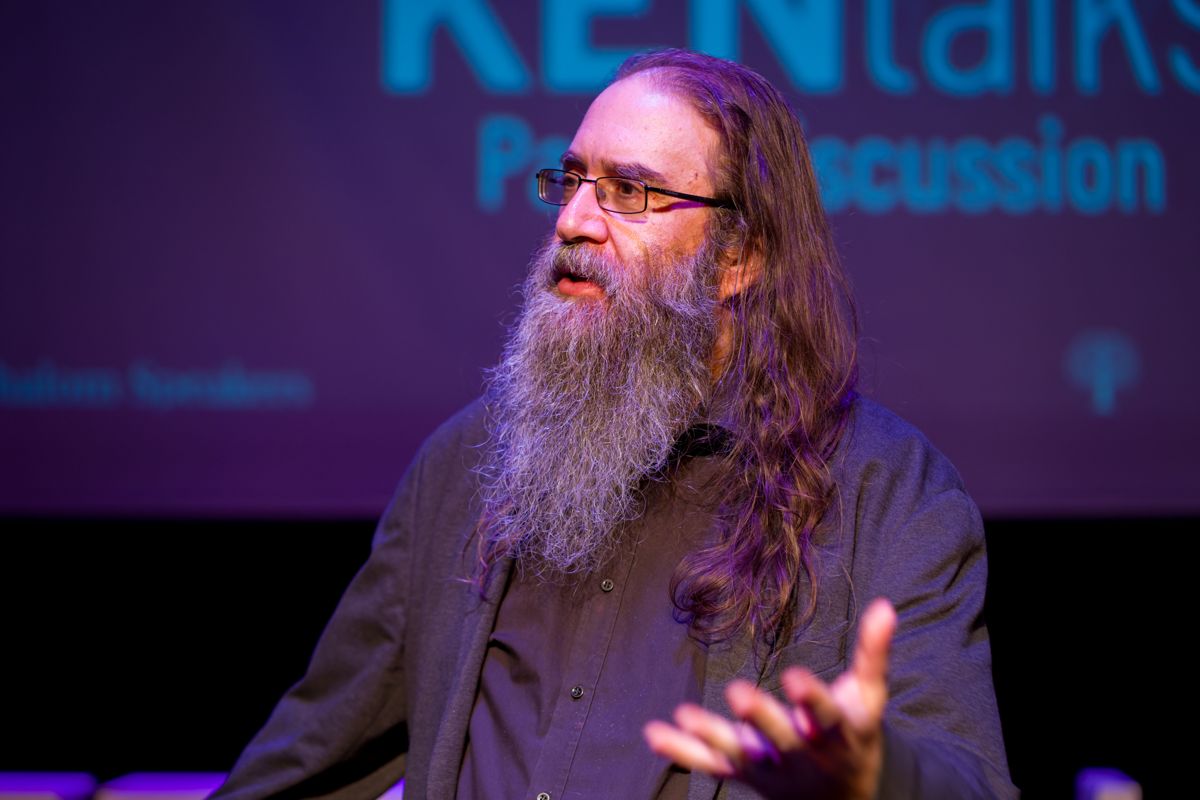
Mid-answer, with the event name on the screen behind · KEN Talks, London
01 · The brief
Who the photos are really for
KEN stands for knowledge, entertainment and networking, and the evening was built around exactly that: a panel discussion on stage, then time for guests to meet. The project credits list Marc Shelkin, Head of Social Media at Maratopia, as director, and Amit Rachmian Sank, founder of Shalom Speakers, as producer. That tells you something useful before you pack a bag: the people commissioning the coverage think in terms of social posts and speaker promotion, not a photo album.
Sources: artsdepot, KEN Talks event page (venue, date, format).
On any conference or panel event, the gallery serves at least four audiences at once, and each wants different frames.
| Who | What they use |
|---|---|
| The organiser | Wides of the stage with the branding, the room, and a few hero frames for next year's promotion |
| The speakers | Clean singles mid-sentence, for their own profiles, speaker pages and press |
| Sponsors | Their product and signage in use, with real guests around it |
| Guests | Candid photos of themselves in conversation, which they share and tag |
If you only shoot the stage, you have served one of the four. The general shot list for any event is in the event photography and recap film guide; this post goes deeper on the parts that are specific to talks and panels.
02 · Stage light
Shooting under a coloured stage wash
The KEN Talks stage was lit in deep blue and purple, with large KEN talks letters on the floor and the event screen behind the panel. That looks great in the room and is hard on a camera: saturated coloured light flattens skin, pushes the blue channel to clipping and makes autofocus hunt in the darker corners.
Expose for faces
Meter on the speaker's face, not the screen. The screen is the brightest thing on stage and will trick the meter into underexposing people.
Shoot raw, set a fixed white balance
Pick one Kelvin value for the stage and keep it, so every frame grades the same way. Auto white balance under coloured light gives you a different skin tone on every shot.
Fast glass, no flash
Flash on stage kills the atmosphere and distracts the speakers. A fast lens and a high ISO keep the coloured light as the audience saw it.
Watch the saturated channel
Check the RGB histogram, not just the brightness one. Blue light clips in its own channel long before the overall histogram warns you.

Two panellists listening while another speaks. The listening frames often say more than the talking ones.
03 · The panel
Singles, pairs and the full line
A panel is several people sitting still for an hour, so the variety has to come from you. Work it in layers: the full panel wide with the branding, then pairs talking to each other, then a tight single of every speaker. Make sure each panellist gets at least a few usable singles; speakers notice when they're missing.


Reactions from the panel. Vertical crops like these go straight into stories and speaker posts.
1. Learn the order of speakers from the run sheet, so you are already framed on the next person before they start.
2. Shoot the person reacting to a colleague's answer. Laughter on a panel happens when someone else is talking.
3. Move to the side aisles for three-quarter angles. Straight-on from the back row gives you a flat line of chairs.
4. Use a long lens for tight singles so you never walk in front of the audience during an answer.
5. Give some frames room for text. Organisers need space for a quote or a speaker name in social graphics.
04 · Brand and sponsors
Details that prove where it was

A branded table sign. Small details like this become the opening frame of a recap post.
Every event pays for things it wants to see again: the logo, the signage, the printed programme, the sponsor's stand. At KEN Talks there was a sponsor's drinks stand in the foyer with product, cups and signage. Photograph it twice: once clean, as a detail, and once in use, with guests picking up a drink. The second is the frame a sponsor can actually post, because it shows real people engaging with the product.

The sponsor's stand in the foyer. Shoot it early, before it gets cleared or crowded.
Ask the organiser for a list of sponsors and their stands before the night, so you can deliver each one a small set of their own. If the sponsor plans to use the images in paid advertising, agree that up front: see usage rights and licensing.
05 · Networking
Candids in mixed light
The foyer is a different job. The light changes from the stage wash to a mix of daylight and warm interior light, so reset your white balance as you walk out of the theatre. Candid networking photos are the ones guests share most, and they work best when people are mid-conversation rather than lined up for the camera.


Networking in the foyer. Shoot over a shoulder to keep the conversation in the frame.
Over the shoulder
Frame past the person someone is talking to. The soft shoulder in the foreground tells the viewer it is a real conversation.
Wait for the laugh
Stay with a small group for a minute. The laugh comes a few seconds after people stop noticing you.
Groups on request
When guests ask for a group photo, take it quickly and well. It's often the one they share that night.
Respect the no
Wides of a busy room are expected. A tight portrait of one person is not, so ask, and honour any no-photo markers.
06 · Delivery
Edit for the people who will post
The KEN Talks gallery holds 115 photographs, from the stage to the foyer, alongside film of the evening. A gallery that size only works if it is easy to use, so sort it the way the clients will look for things.
1. Order the gallery as the night ran: arrivals, the panel, the host, the foyer.
2. Make sure every speaker has a set of strong singles they can find quickly.
3. Give sponsors their own small selection.
4. Deliver a handful of the best frames the same night or first thing the next morning, while people are still posting about the event.
5. Cut the duplicates hard. Five near-identical frames of the same smile waste a client's time.
If the event also needs video, the same planning applies to speaker clips and recaps; the video podcast production guide covers clean sound for people talking on camera.
Watch
Event films
 L'Atelier Five at Opera Gallery London
 Shinz event, Dubai
 Anabela Chan event for Damas
 Dorra Zarrouk relaunch event
More guides
Keep reading
FAQ
Common questions
What should a conference photographer shoot?
The stage with the event branding, every speaker mid-sentence, the panel as a group and in pairs, audience and panel reactions, sponsor stands and signage, and candid networking between sessions.
How do you photograph speakers under coloured stage lighting?
Shoot raw with a fixed white balance, expose for faces rather than the screen, use a fast lens instead of flash, and check the RGB histogram so the saturated colour doesn't clip.
How do you photograph a panel discussion?
Work in layers: the full panel wide with branding, then pairs, then tight singles of each speaker from the side aisles with a long lens, and catch panellists reacting to each other.
How quickly should event photos be delivered?
A small selection the same night or the next morning, so organisers, speakers and sponsors can post while the event is fresh, then the full sorted gallery a few days later.
Written by Joshua Swain, who photographs and films events, brands and people in London and Dubai. See the full KEN Talks gallery.